Community Meets on Thursday to Discuss
Written by Laura Everett
Edited by Abbi Holt
Thursday July 13, 2023
Boston’s bid for a professional women’s soccer team moved a few steps closer to the goal this week with the announcement that the Boston Unity Soccer Partners were the sole bidders in the City of Boston’s Request for Proposals to redevelop White Stadium in Franklin Park. The 59-page Technical Proposal will be discussed at the Thursday July 13 online community meeting hosted by the City of Boston and Boston Public Schools, which owns the stadium.
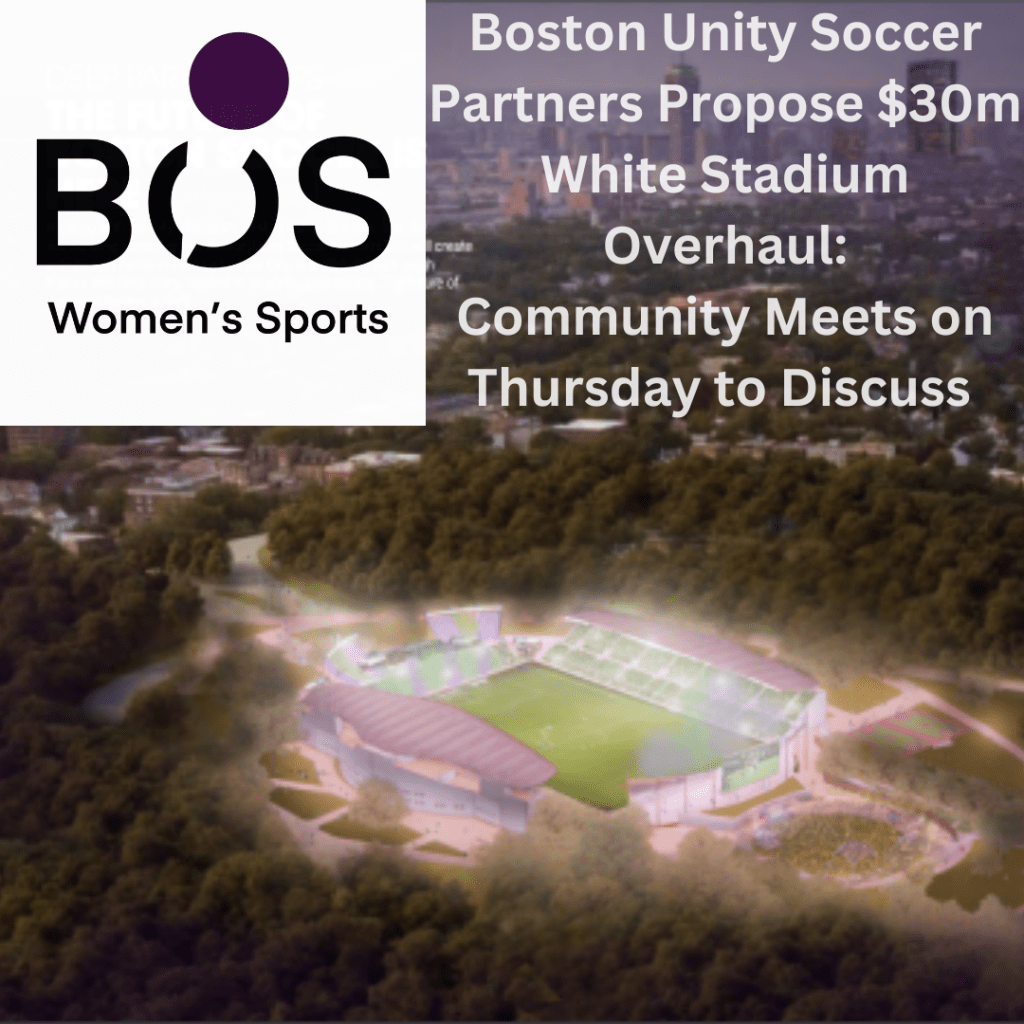
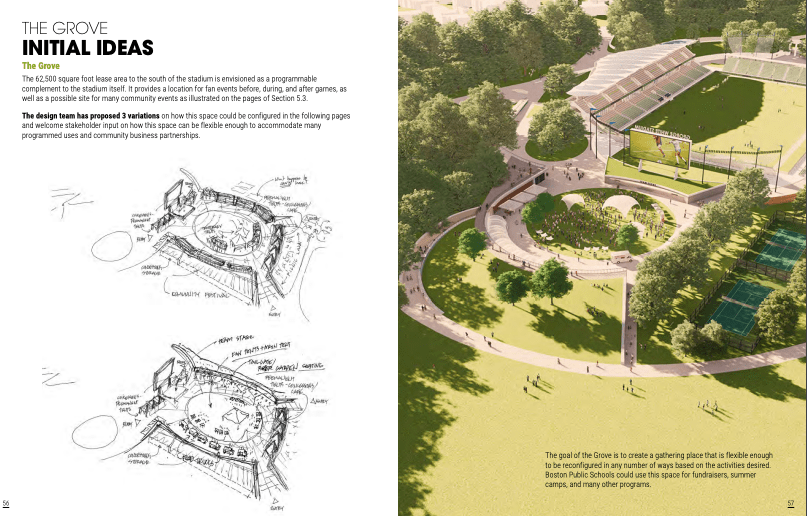
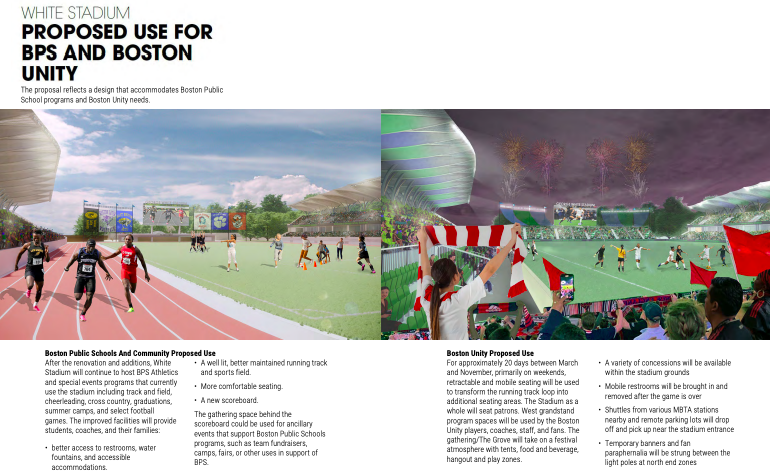
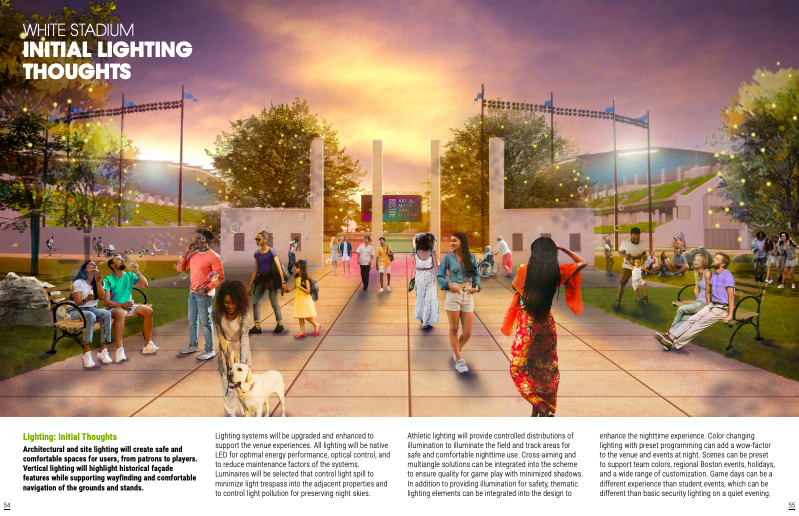
The Boston Unity Soccer Partners propose a $30 million dollar renovation of the historic 1950’s White Stadium, with a ten-year, renewable lease that would allow both their professional women’s soccer team and Boston Public Schools regular use. With seating for up to 11,000, the refurbished stadium would have bucket seating, retractable and mobile seating on the track for soccer matches, a new scoreboard and covering over West and East grandstand seats. Additionally, a new fan and community amenity area called “The Grove” in front of the stadium would be run by a separate operating company.
The release of the Technical Proposal prior to Thursday’s community meeting answered a number of previously unknown questions for those who have been curious for more details about the Boston NWSL bid. Additionally, since news broke in January 2024 of Boston as a National Women’s Soccer League (NWSL) expansion bid, the all-women’s Boston team has made a number of significant changes and many more details are now known.
- First, the clarity of the team name: welcome, the Boston Unity! Boston Unity Soccer Partners has now incorporated in Delaware as a limited liability corporation. Those who hoped to bring back the Boston Breakers can lay that dream aside.
According to the flow chart on pages 18-19 of the proposal, there will be three related, but separate entities: Boston Unity Soccer Partners; Boston Unity Soccer Club; Boston Unity Community Action (the non-profit), in addition to the separate ownership of “The Grove” outdoor social space and the White Stadium Operating Company.

- Second, since the January announcement of the Boston NWSL bid, Boston Unity Soccer Partners has added two new founding funders to the initial four women lead owners (Jennifer Epstein, Anna Palmer, Stephanie Connaughton, Ami Kuan Danoff): Jasmine Robinson and Linda Whitlock. Miami-based investor Jasmine Robinson comes to Boston Unity from the Monarch Collective, a new venture capital fund created with Kara Norton. Kara Norton is a co-investor in the NWSL’s hugely successful expansion team Angel City FC. While Robinson’s sports credentials are stellar, her local connections seem to be only from her undergraduate years at Harvard.

The second new investor is Linda Whitlock, who is well known to many Bostonians for her many philanthropic and civic works, including serving on the boards of the Red Sox foundation and Brigham and Women’s Hospital. But most Bostonians will know her for leading the Boys and Girls Club from 1999 to 2008. Adding local Black investors to the initial group of funders will certainly support the credibility of this project.
The failed 2024 Olympic bid is a jeremiad in what not to do when a majority-white, majority-male group of wealthy Bostonians decides they want to host a sporting event and then tells the community how it will happen. At the time, Franklin Park was slated to host equestrian events.
Read our Boston Women’s Sports most read article: “An Antiracist NWSL Bid for Boston”
- Third, the technical proposal finally gave hungry Boston fans a timeline for a team to be playing locally. While Utah Royals are slated for restarting in the 2024 season, Boston initially looked like it might come in with the Bay area bid. But Bay FC appears poised to enter in 2024 while hopefully riding a post World Cup wave. Bay FC just announced this June with logos that look strikingly Bostonian, and is teasing two possible stadiums that are already soccer ready. The Boston Unity proposal makes clear that the redesign and rebuild of White Stadium aims to be game ready for a first match in March 2026.
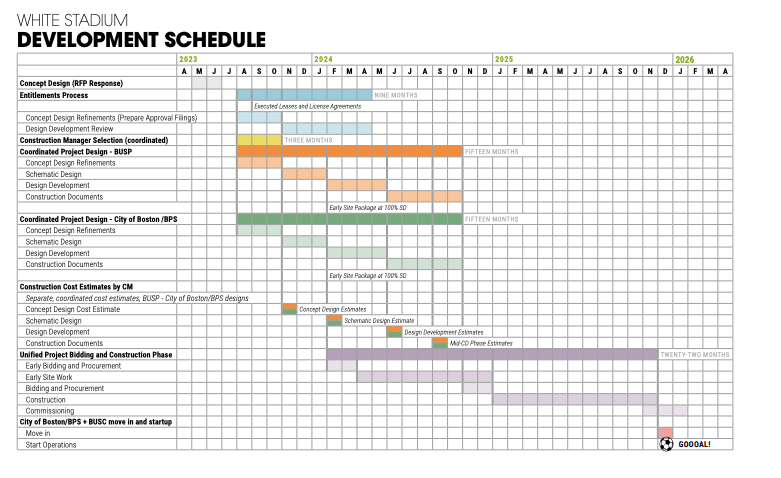
While this timeline is further out than many Boston NWSL fans might like, the full redesign and rehab of White Stadium as proposed is a thorough process. White Stadium, opened in 1949, is deeply in need of repair. The stadium was slated for rehabilitation back in 2013 under Mayor Tom Menino but that plan was shelved due to cost and political delays. Given the need for community engagement and the global delays in construction, this almost seems like an aggressive timeline.
- Fourth, we learned of the need for an additional Boston Unity practice facility. This proposal names approximately 20 NWSL games annually to be played at White Stadium, including some pre-game practices. That means that other practices will need to occur at a yet-to-be identified practice facility. As we’ve seen with other expansion teams in the NWSL, partnership with local universities or men’s teams is always a possibility. Angel City FC will practice at Cal Lutheran. San Diego Wave played their initial home games at the University of San Diego’s Torero Stadium until the completion of the new Snapdragon Stadium. But the NWSL and soccer are shifting, as teams are distinguishing themselves with soccer specific stadiums and training facilities. Setting and raising the bar, in June 2022, the Kansas City Current opened an $18m women’s soccer specific training facility. In June 2023, the final beam was put in place for the first soccer stadium purpose-built for a professional women’s soccer team in Kansas City. Total cost? $117 million.

Notably missing from the Boston proposal are many details about the field, including drainage, grass, turf and other specifics. The only mention of the field is: “We intend to operate and maintain the stadium field on behalf of the Boston Public Schools allowing BPS to redirect funds that otherwise would be dedicated to maintenance to new programming for educational purposes. We anticipate the annual maintenance budget for this purpose to be $400K+” .
Given the preponderance of knee injuries plaguing women’s footballers and other gender parity issues, turf will finally not be allowed for the 2023 Women’s World Cup . We understand this may be the kind of information for a later stage report, but the field itself is a topic to bookmark.
- Fifth, the technical proposal included some very interesting interesting local details. There is enough to envision what is possible, but not so much that the community cannot add their input. The division of labor has Boston Unity building out the West Grandstand and the City of Boston rehabbing the East Grandstand, which could be a potential point of friction later on.
The Technical Plan wisely states “there are many variations that could continue to be explored as the design process continues and we engage with many stakeholders.” The Grove” has three possible designs available for community feedback, each with concession stands, seating and performance areas outside of the stadium. Should “The Grove” be more like a “Tent Village” with separate seating areas under mobile canopies or more like mounded earth with a hidden walkway to a submerged seating area?

The transportation management details in section 5.6 are a fascinating study in local sports event management. The Boston Unity planners estimate how people get to a game for an urban stadium by using data most recently gathered from what modes of transit people use to get to Fenway Park. From this, they extrapolate the percentages of people who they think will walk, bike, drive, taxi, and take public transit to the stadium and therefore how to plan for it. Similarly, when Brookline Golf Course recently hosted the U.S. Open Championship without any on site parking, they successfully used a required pay-ahead parking model for off site parking. Boston Unity sees this as proof of concept that it is possible to train thousands of car-bound visitors to pay ahead for off-site parking and shuttle to game sites.
Buried deep in the proposal is a note including Needham local and gymnast Aly Raisman as a team owner, and player safety advisory. On page 99, “Olympic gymnast Aly Raisman will be a Team Owner and Advisor on issues related to player experience, safety and development; and Richard Taylor, a founding father of the “Massport Model” will be a D&I advisor for the Project.” For everyone who cares about player safety following the harrowing Yates report on abuse across US Soccer, the inclusion of Aly Raisman and her strong advocacy for women athletes is an excellent sign.
- Finally, the technical proposal includes some, though not all, of the commitment to diversity and inclusion that we expect from any team entering the league and any group committing to Boston. Whether this holds up through the stadium and team building process is yet to be revealed, but there are good initial signs.
For those familiar with local politics, the operating logic Boston Unity is proposing for their contracts with local businesses is to use the “Massport Procurement Model,” which is a short way of saying that a bidder scores higher (and thus is more likely to win a contract) by having a more diverse bidding team. This is a very good sign.
In section 5.5 on Facilities Management and Operations, Boston Unity “intends to offer a wide range of pricing to its games and events.” This includes discounted supporter section pricing and “subsidized BPS pricing to benefit children and low income residents at every Boston Unity event. The promise that Boston Public School students (and hopefully staff) would receive discounted tickets to every Boston Unity game is a logical and wise commitment to the community.
The bid also promises the development of a “youth academy to foster homegrown talent,” which is pretty par for the course for any pro women’s team. What hopefully makes this bid both different and specific to the majority Black and Brown neighborhoods surrounding it is the naming of the leagues this youth academy intends to partner with: “Soccer Unity Project, Jamaica Plain Soccer, Dorchester Youth Soccer, Roxbury Youth Soccer, Boston Scores.” This is a hopeful sign that the Boston Unity Youth Academy doesn’t simply turn into another pipeline for wealthy youth, but can actually nurture local players who have been historically denied access to upper levels of soccer development in the US systems.
Boston Unity’s diversity commitments expand on the economic development side, too. The bid states “after completion of the stadium renovation, the Boston Unity Soccer Club expects to create 300 new permanent jobs both directly as the employees of the company and indirectly as third party vendors.” As in other places, the softer language of “expects” and “aims to” is a bit aspiration on the diversity commitments, but not surprising given the legal constraints. The commitment to have at least 50% of vendors, contracts, merchandise, and food options from local businesses is solid. The naming of working with BECMA (Black Economic Council of Massachusetts) is both wise and expected at this point, though there are other economic development organizations with whom to be partnering.
It is absolutely essential to work with the five neighboring Main Street Associations to support and draw in local businesses, as one thing often stated from local minority owned businesses is that the bidding process for new contracts is often out of their reach. Franklin Park abuts Jamaica Plain, Roxbury, Dorchester and Mattapan, and the Boston Unity proposal rightly commits to working with the Main Streets business partnerships in each community for the economic flourishing that can come with vendors selling in The Grove or in the grandstands. For this stadium, and for this team to truly be about a unified Boston, it must work from the start with these five neighborhoods.
For Bostonians, the 130 year old Franklin Park is in the midst of generational change. The Franklin Park Action Plan is the guiding rubric for major revisions across the Frederic Law Olmstead designed 485-acre park. On the other end of Franklin Park, the Shattuck Hospital is undergoing a similar process of redesign and community engagement, with some neighbors lobbying that the hospital should be returned to parkland and others advocating for repairs and more transitional housing for the state’s most vulnerable. In June 2023, Boston Medical Center was provisionally designated by the state as the redevelopment partner for the Shattuck campus. A community meeting will be held on Thursday July 20 to discuss the next stage of redesign.
White Stadium has the designation of a historic landmark by the Boston Landmark Commission, which complicates things further. As the technical proposal notes, “the stadium is out of compliance with building codes, has had significant fire damage, and lacks accessible accommodations.” White Stadium is both a historic landmark, and frankly, a bear to overhaul. There is a lot of work to be done and a ton of deferred maintenance that the City of Boston and Boston Public Schools have failed to do. Somehow this work of deferred maintenance always seems to fall on women.

With Boston Unity’s sole bid for White Stadium, the City of Boston’s desire for local investment and Boston Public Schools’ need for functional facilities, this bid is likely to be positively received by the city.
Certainly, to rebuild White Stadium would cause some disruption. Can Bostonians imagine a functional, joyful, community facility? What remains to be seen is how the neighboring communities of Jamaica Plain, Roxbury, Dorchester, and Mattapan receive the proposal.
 Boston Women's Sports
Leave a comment