Written by Laura Everet
Edited by Abbi Holt
With the announcement from National Women’s Soccer League (NWSL) Commissioner Jessica Berman made what has been long rumored very official: professional women’s soccer will return to Boston in 2026.
“We are very proud to welcome Boston Unity Soccer Partners to our ownership group. They bring an impressive roster of business leaders committed to continuing Boston’s legacy of sports excellence and delivering a successful team to a very passionate fanbase,” Berman said.

Original photo credit: Billie Weiss Photography
This time around, a Boston professional women’s soccer team will not have to endure the uncertainty of playing in leagues teetering on collapse. This time around, a Boston professional women’s soccer team enters into a fascinating private-public deal that will rehabilitate a 70+ year old stadium owned by Boston Public Schools.
Read our story on the $30 Million Dollar Plan to Repair White Stadium
Questions remain: Will the exceedingly male-focused and male-dominated Boston sports media actually report on a women’s team this time? Will local businesses advertise and support the team? How much has changed since a Boston professional women’s soccer team last played in Boston in 2018?
On Tuesday September 19, 2023, Boston Mayor Michelle Wu, NWSL Commissioner Berman, and Boston Unity Soccer Partners all-women’s investor group publicly announced the new team. The team site already has green and black merchandise with a crest based on the iconic Zakim Bridge in the team store, though the crest is rumored to be just for the team launch.
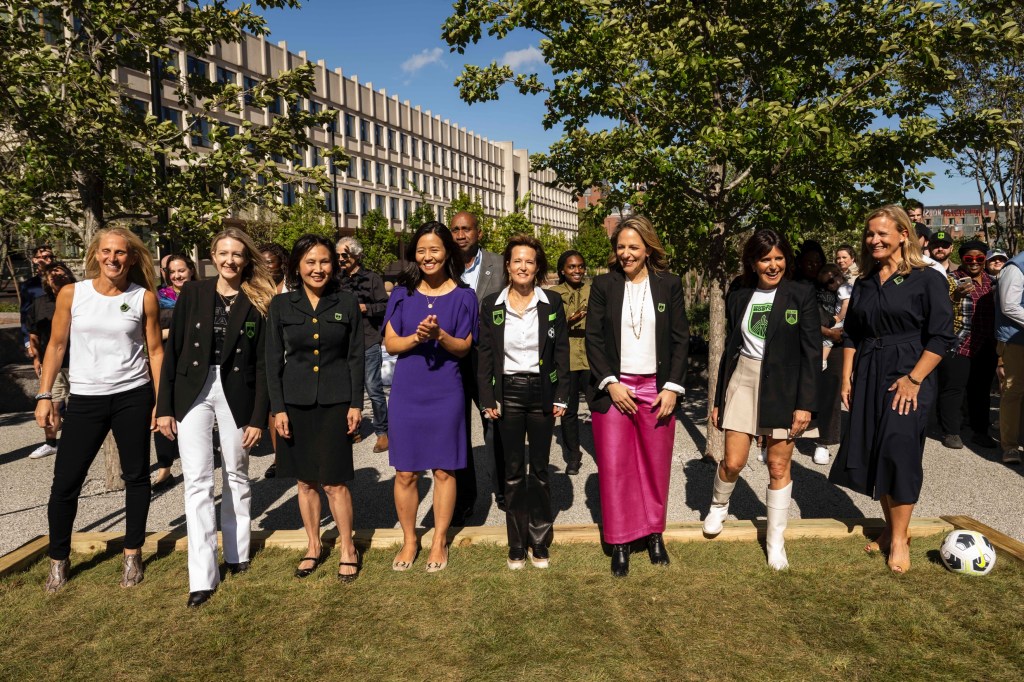
Photo credit: Billie Weiss Photography
Enthusiasm was high and turnout for a windy Tuesday afternoon on Boston City Hall plaza was strong. Free tee-shirts with the new logos were scooped up by enthusiastic fans. Young athletes from Boston Public Schools participated in a skills clinic. Boston Unity Soccer Partners announced that 95% of their funding is coming from women and 40% is coming from investors of color.
Read our opinion piece: “Making an AntiRacist NWSL Bid for Boston”
Mayor Michelle Wu emphasized heavily the unique partnership between the city of Boston and the private equity partners in rehabilitating and then sharing White Stadium. “This will be the first professional sports team to be co-housed along with public school athletes in a public school district facility. The team’s success then, is about more than adding to the banners that we’re very proud to count. The team’s success is truly the success of our city and of our young people and of our Boston Public Schools.”
For citizens of Boston and tax-payers of the Commonwealth, avoiding a taxpayer funded stadium boondoggle is a major victory. While wildly popular, government subsidies to fund sports stadiums are generally bad policy. A comprehensive study over 30 years and 130 studies found that “the large subsidies commonly devoted to constructing professional sports venues are not justified as worthwhile public investments.” Thus, Mayor Wu’s ability to thread the needle by getting White Stadium rehabbed for Boston Public Schools through private funding by Boston Unity Soccer Partners and bringing another pro sports team to the urban center without government subsidies is a major coup.
Yet there is still a way to go, both in the work for the City of Boston and for Boston Unity Soccer Partners. The next meeting about White Stadium will focus on transportation. The in-person meeting scheduled for Tuesday September 26th 6-8 PM at White Stadium, 450 Walnut Ave was postponed due to field conditions. The virtual meeting is Wednesday September 27th 6-8 PM with registration available here.
Boston Unity Soccer Partners, operating under NWSL Boston on their website and social media, have just begun to introduce themselves to their potential fans. The feel good vibes from the City Hall launch with US Women’s National Team icons Kristine Lilly and Sam Mewis rolled over into an afterparty at a restaurant owned by controlling partner Jennifer Epstein. The initial proposal for the White Stadium Renovation featured two additional funders Jasmine Robinson and Linda Whitlock who were in attendance on Tuesday, but not featured in the current promotional materials for Boston Unity Soccer Partners.
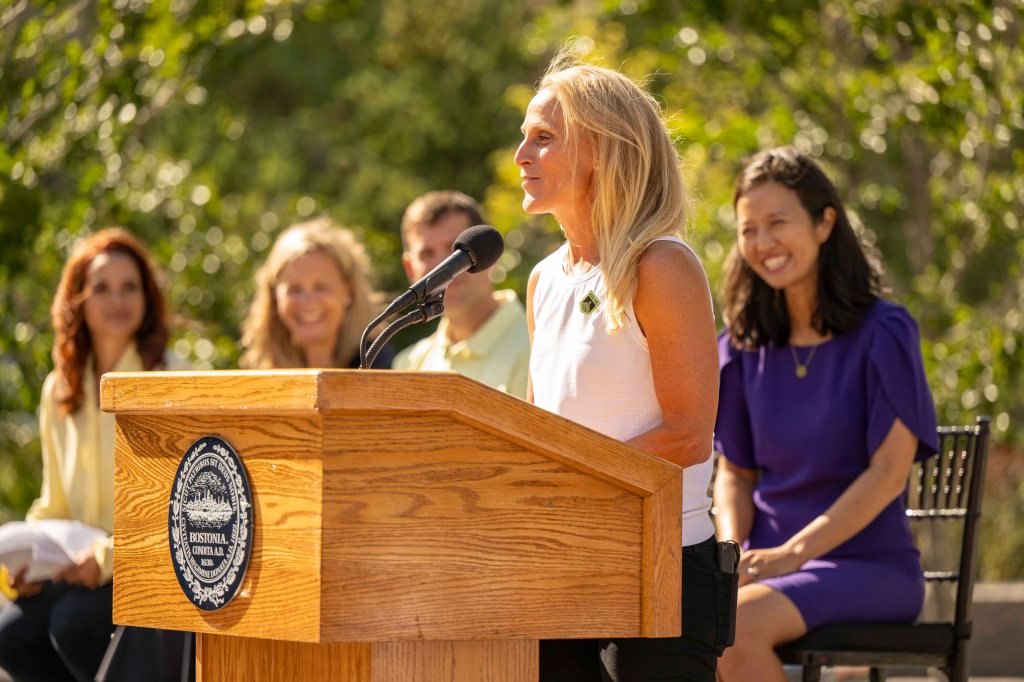
Photo credit: Billie Weiss Photography
As Epstein writes in the introductory letter to fans, “Our team needs to represent you, and we will do that by investing in our players, our facilities, and our communities so that your experience as a fan is everything you want it to be, so that our team is yours.” If this NWSL Boston is to truly represent Boston, now a “majority minority” city, it will need to look a lot more racially diverse. There is time to grow and expand, but it needs to happen intentionally.
The original Boston women’s pro-team was the Boston Breakers, on which Lilly played. The Breakers played in four separate leagues: the Women’s United Soccer Association (WUSA) from 2001-2003 until the league folded, Women’s Professional Soccer (WPS) from 2008-11 until the league suspended, a semi-pro Women’s Premier Soccer League Elite (WPSL Elite) for the 2012 season, the National Women’s Soccer League (NWSL) for the 2013 season until the team folded in 2018.
Instability creates the conditions that neither players nor fans can trust. Why follow something that will disappear? If your team may barely exist the next day or next season, what are the odds of even finding it on television? How do you follow a team if you can’t find anyone writing about them?
Meanwhile, Boston sports media is already busy scolding fans for not supporting the Breakers enough, with zero self-reflection on how little the self-same media failed to cover the Breakers and contributed to the problem.
At the press conference launching the new NWSL Boston, Commissioner Berman referenced Boston’s past history with the league. Of the Boston Breakers, Berman said, “their iconic talent and greatness was unable to shine because the world wasn’t ready for it. The state of the league today is ready for it.”
This new Boston team exists in a massively different sporting world than that of the shuttered Boston Breakers. The chronic league instability that hung over the head of every player as a constant threat to accept low pay and subpar work conditions, and for some, a sort of sexist proof that no one watches women’s soccer, is gone. Ten years in, the NWSL is here to stay.
NWSL Boston is $53 million dollars here to stay. With a $30 million dollar investment, a rehabilitated White Stadium is also here to stay. After a buoyant Women’s World Cup and a rising NWSL, women’s soccer fans are here to stay.
The million dollar question is whether the investors, local media, broadcasters, and advertisers will also stay.
 Boston Women's Sports
Leave a comment